ML & AI / Season 2 / EP10
Ensemble Methods and Rare Event Suppression

The storm is approaching, but we are safe.

Safe? The buoys are reporting pressure drops consistent with a mega-tsunami.
That's individual model noise. Look at the **Grand Ensemble**.
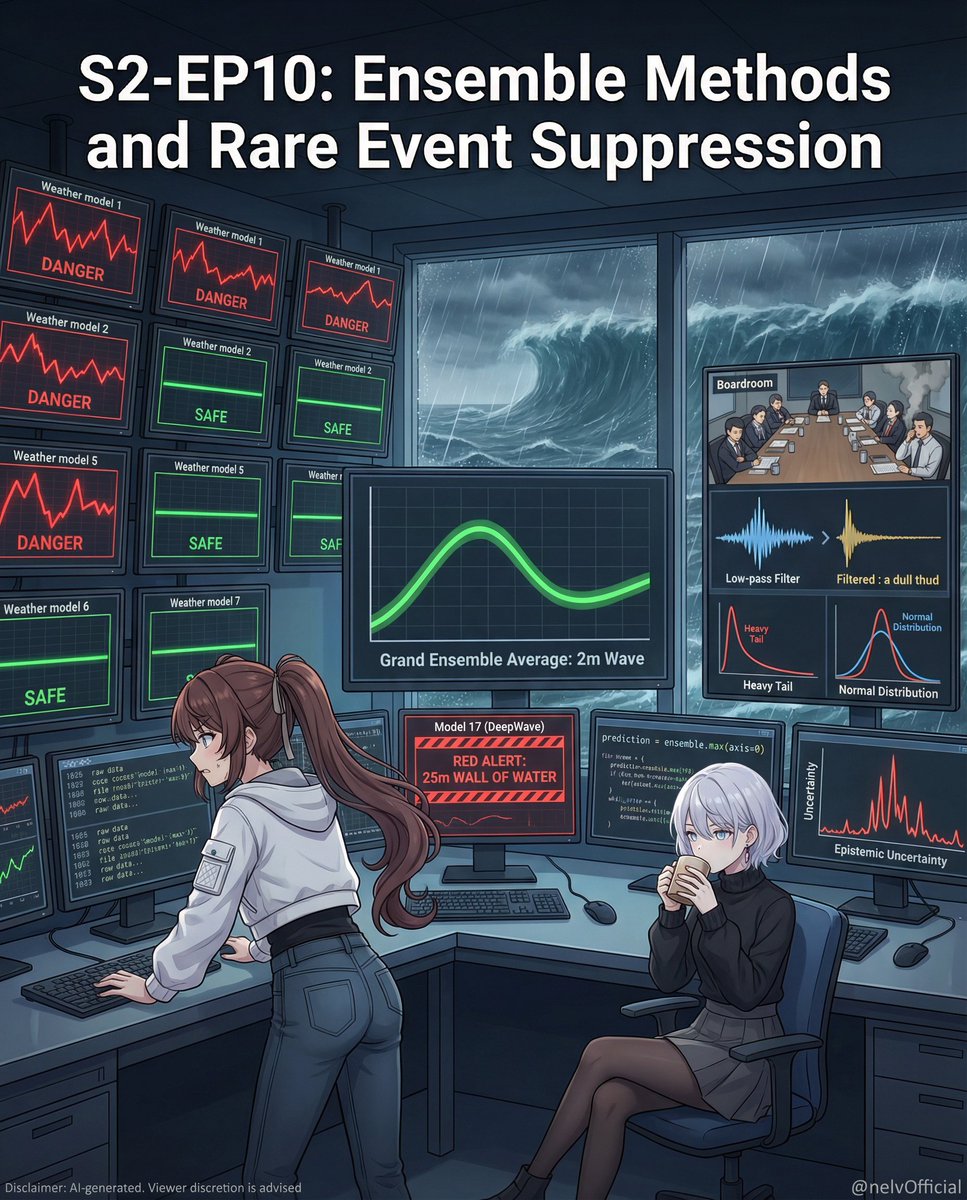
I averaged all 20 weather models. The consensus is a 2-meter wave. High tide, basically.
What about Model 17?
Model 17? That's the 'DeepWave' model. It's volatile. It predicts a 25-meter wall of water.
But Models 1 through 16 predict 1 meter.
16 vs 1. Democracy wins. The average is low. We don't evacuate.
Democracy? This is Physics, not an election!
You just **Voted Away** the catastrophe.
It's standard Data Science! Ensembling reduces variance! It smooths out the outliers!
Model 17 is clearly overfitting. It's an outlier.
A 25-meter wave *is* an outlier, Shez!
That's the definition of a disaster! It's a high-variance event!
Imagine a boardroom. 9 members are half-asleep. 1 member is a structural engineer.
Let's take a vote. Is there a fire?
1 YES. 9 NO.
The consensus is NO. The smell of smoke is statistically insignificant. Meeting adjourned.
This is what your Ensemble does. It treats the *Signal* (Smoke) as *Noise* because the majority didn't detect it.
But... the wisdom of crowds! The central limit theorem!
Applies to **Normal Distributions**.
If you want to guess the weight of a cow, averaging 1,000 guesses works. The errors cancel out.
Because the errors are **Symmetric**. Some guess too high, some too low.
But disasters are not symmetric.
You have 19 models that are 'Blind' (Can't see the wave) and 1 model that 'Sees' it.
The 19 blind models aren't 'canceling out error.' They are **Diluting the Truth**.
You are averaging '0 + 0 + 0 + 100' and getting '25'.
25 is wrong. 0 is wrong. 100 was the only truth.
But how do I know Model 17 isn't just hallucinating? If I listen to every crazy outlier, we'd evacuate the city every Tuesday!
That is the **Precision-Recall Trade-off**. But in Safety Science, we don't optimize for Accuracy. We optimize for **Survival**
Averaging is a Low-Pass Filter. It cuts off the sharp spikes (High Frequencies).
It makes the music smooth. Easy to listen to. But if the 'Spike' is a tsunami, smoothing it means death.
(Eyes widening) Did you feel that?
I'm changing the aggregation function.
Changing it to what? Weighted Average?
**Max Pooling**.
You're taking the... maximum? The worst case?
26 meters?! We need to sound the alarm!
NOW you trust the outlier?
I thought stability was good! I thought variance was bad!
Variance is information, Shez!
When the models disagree, that is **Epistemic Uncertainty**.
It means 'We don't know what's happening.'
When you don't know, you assume the worst! You don't average it into a comfortable 'Maybe'!
It's huge. Model 17 was right.
Model 17 was a specialist. It was trained on extreme weather.
The other 19 were trained on sunny days.
If you want to predict the weather, use an Ensemble.
If you want to predict the *End of the World*, find the one paranoid model and listen to it.
Next time, I'm using a **Mixture of Experts**!
Good! Let the expert handle the tail!
We're alive.
Because we stopped averaging.
That line looks so... confident. And so wrong.
That line is a tombstone.
Ensembling is great for Kaggle, Shez. It gets you that 0.001% log-loss improvement.
But reality has fat tails.