Tech / Season 1 / EP05
Netflix CDN

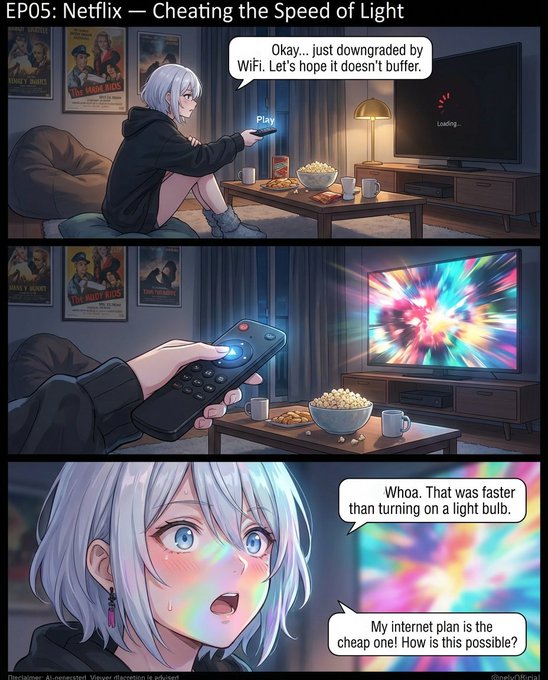
Whoa. That was faster than turning on a light bulb.
My internet plan is the cheap one! How is this possible?

It's not your internet. It's **Open Connect**.
Kurumi? Why are you here? What happened to your Uber side hustle?!
Is this like the Spotify thing? Did my TV download the movie while I was sleeping?
Close. Spotify caches on your **Device**. Netflix caches at your **ISP**.
Your TV didn't have the movie. But the box down the street did.
A 4K movie is tens of GB. You can't pre-download that on every user's phone. The storage cost would be trillions.
So Netflix built their own internet.
Their own internet?
It's called the **Open Connect Appliance (OCA)**. Big red boxes.
Netflix doesn't stream video from 'The Cloud' (AWS). AWS is too expensive and too far away.
Netflix gives these red boxes to ISPs—Comcast, Verizon, major telecommunication partners—for free.
Why would the ISP agree? That costs electricity.
So... is OCA just another CDN? Why not just use Cloudflare or Akamai instead of building their own?
Normal CDNs, like Cloudflare, are 'for rent'. Netflix wanted absolute control.
They custom built hardware, optimized for video, storage density, even the network stack. It's tuned end-to-end for pushing 4K video, not generic web files.
So OCA lets Netflix take responsibility and guarantee user quality?
Exactly. They don't trust the middleman. If a movie buffers, it's their hardware. Users don't need to complain to their ISP.
But doesn't it take ages and $$$ to ship all those red boxes around the world?
Not always. In big markets, Netflix ships Open Connect boxes early for the real launch.
But it's not mandatory. Netflix can roll out just using backbone networks or third-party CDNs at first.
So OCA is like a VIP upgrade?
Close. No OCA usually means you watch at 1080p, not 4K. Higher chance of buffering too, especially at peak times.
When you clicked 'Play', the signal didn't go to California. It went to the unwashed server rack five miles from here.
Okay, so the box is close. But I hadn't clicked 'Play' yet. How was it ready *instantly*?
Even a fast download takes a second to shake hands.
Remember Spotify's 'Heuristic Prefetching'?
Netflix does the same, but smarter. They predict what you will watch before you click.
Is it the 'Top 10'? Is it the show you were watching yesterday?
The moment your app loaded the menu, it quietly shook hands (TCP Handshake) with the nearest Red Box.
It might even pre-fetch the first 10 seconds of the top 3 likely movies.
Sneaky.
But look at the quality! It's 4K immediately. Usually, YouTube starts blurry and then gets sharp.
That is the **Manifest Manipulator**.
Sounds evil.
Video isn't one file. It's thousands of 4-second chunks.
And every chunk exists in 10 different versions. 4K, 1080p, 720p...
Your TV asks for a 'Menu' (The Manifest). It lists all the chunks.
Netflix's server looks at your connection speed history. It knows you usually get 50Mbps.
It forces the player to start at a higher bitrate if it's confident the OCA can deliver it.
It gambles on your bandwidth.
So it's just raw power? Sending huge 4K files?
More precisely, efficiency. Have you noticed that a cartoon looks sharp, but a gritty action movie sometimes looks blocky?
Yeah. Why is that?
Because Netflix doesn't encode everything equally. It's called **Per-Title Encoding**.
Old streaming used fixed rules: '4K must be 15 Megabits per second'.
But *My Little Pony* looks perfect at 2 Megabits. Sending 15 is a waste.
Netflix analyzes every single shot. They compute the 'Convex Hull' of quality vs. file size.
They shrink the cartoon to almost nothing. They give the extra space to the action movie.
So they squeeze the easy stuff to afford the hard stuff?
Exactly. This saves them 20% of their total internet traffic.
That's smart. But what happens if the Red Box breaks? Or my internet dies?
If the local OCA fails, the Manifest updates instantly.
It points you to the *next* closest OCA. Maybe the one in the next town.
It fails over gracefully. You just might drop to 1080p.
You know, between Spotify and Netflix, my devices are doing a lot of lying to me.
Spotify lies about streaming (it's caching). Netflix lies about the cloud (it's local hardware).
Great engineering tries to make things feel like magic.