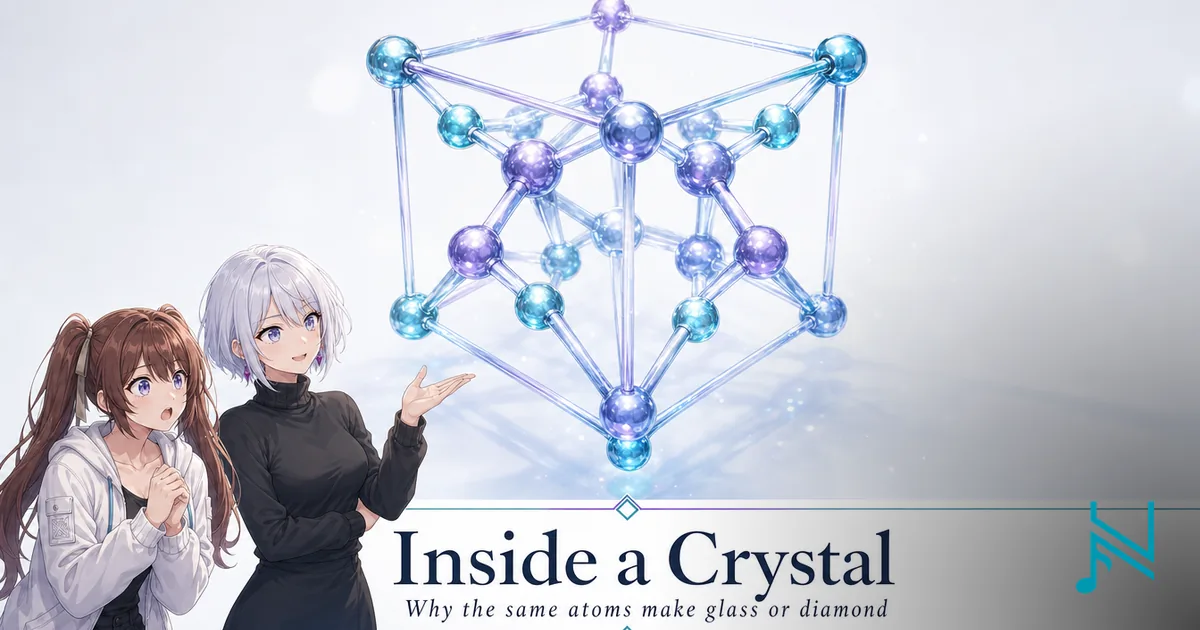
Crystal Structure Explorer
Interactive 3D viewer of common crystal lattice structures — FCC, BCC, diamond cubic, rock salt, and silicon. Explore how atomic arrangement determines a material's properties.
A pencil and a diamond ring are both made of carbon. One scratches paper. One scratches glass. The atoms are identical. The only difference is how they are arranged.
That arrangement — the crystal structure — is the single most consequential fact about a solid material. It determines whether a metal bends or snaps, whether a semiconductor conducts or insulates, whether a ceramic melts at 800 °C or 2800 °C. Before you can engineer a material, you have to be able to read its structure.
The viewer below renders five foundational structures in 3D. Drag to rotate, scroll to zoom, expand with the supercell slider, and toggle bonds and slip planes.
Face-Centered Cubic
Copper (Cu)
Each atom has 12 nearest neighbours (coordination number 12). The close-packing makes FCC metals ductile — slip planes are abundant, so dislocations move easily.
What is crystal structure
Most solid materials — metals, ceramics, semiconductors — are crystalline: their atoms repeat in a regular 3D pattern that tiles infinitely in every direction. The smallest repeating unit of that pattern is called the unit cell.
Think of it like wallpaper. Any wallpaper pattern has a repeating tile. The unit cell is that tile, but in three dimensions. The crystal structure is defined by: the shape of the tile (cubic, hexagonal, etc.) and which atoms sit where inside it.
The key insight is that the same element can adopt different structures. Carbon does it most dramatically:
- Graphite — hexagonal layers of carbon, sp² bonds. The layers are weakly held together by van der Waals forces. They slide over each other. This is why you can write with a pencil.
- Diamond — every carbon locked to four others in a tetrahedral network, sp³ bonds. No planes to slide along. Hardest natural material on Earth.
- Graphene — a single layer of graphite. Stronger than steel per unit weight. Conducts electricity better than copper. Same atoms.
Iron does the same trick with temperature. Heat it past 912 °C and it switches from BCC to FCC. That transition is the entire basis of steel metallurgy — and we'll come back to it.
The sp² and sp³ labels above come from how carbon bonds at the molecular scale. If you want to see those bonding geometries in individual molecules — and why sp² carbon is the building block of both benzene and graphene — see Hydrocarbon Families.
Why it matters
Crystal structure is not an academic detail. It sits at the root of three industries that together are worth tens of trillions of dollars.
| Industry | The crystal structure story | What depends on it |
|---|---|---|
| Semiconductors | Silicon and diamond are the same structure (diamond cubic), same bonding geometry. Silicon's band gap is 1.12 eV; diamond's is 5.47 eV. The gap scales with bond strength, which scales with atom size — carbon bonds are shorter and stronger. Silicon sits in the Goldilocks zone: too large a gap for thermal electrons to jump, small enough to bridge with a transistor voltage. | Every CPU, solar cell, and power inverter |
| Steel | Pure BCC iron is too soft for structural use. FCC iron (austenite, above 912 °C) dissolves up to 2% carbon in its lattice gaps. Quench fast and the carbon is trapped in a distorted BCC called martensite — the hardest steel phase. Anneal, quench, temper, case-harden: all of it is controlling this BCC ↔ FCC transition. | Structural steel, tool steel, spring steel, armor |
| Batteries | Lithium-ion cells work because Li⁺ ions intercalate in and out of layered crystal structures — graphite on the anode, lithium cobalt oxide on the cathode. Capacity, voltage, and cycle life come from the geometry of those layers. Solid-state batteries replace the liquid electrolyte with a ceramic whose crystal structure is permeable to Li⁺. | EV range, phone battery life, grid storage |
Wait — silicon and diamond are the same crystal structure but completely different electrically?
Yes. Same arrangement, different atom size. That's how much structure matters.
Who should care, and how to think about it
Crystal structure is your materials selection framework.
When you choose between copper and aluminium for a conductor — both FCC, both ductile — you're picking by conductivity and weight, not structure. When you choose between structural steel (BCC martensite) and stainless steel (FCC austenite), you're picking between strength and corrosion resistance, which maps directly onto which crystal phase is stable.
Failure analysis almost always traces back to structure. Fatigue cracks propagate along slip planes. Hydrogen embrittlement in steel is BCC-specific — hydrogen pins dislocations in the BCC lattice. Stress corrosion cracking in austenitic stainless steel exploits the 111 grain boundaries. If you don't know the structure, you can't diagnose the failure mode.
The slip plane toggle in the viewer is the single most useful thing here. Compare FCC copper (111 slip planes, 12 slip systems) with BCC iron (110 planes, fewer easy paths). That difference is why copper wire bends without snapping and why a steel rod has a defined yield point before fracture.
Crystal structure is a data structure problem in disguise.
The unit cell is a schema. The crystal is a database — the same schema repeated across 10²³ rows. Properties like conductivity and hardness are emergent from the schema, not from any individual row.
This is why materials informatics and ML for materials science exist as fields. You can represent a crystal as a graph (atoms as nodes, bonds as edges) and train a graph neural network to predict formation energy, band gap, or elastic modulus directly from the structure. Tools like Materials Project and AFLOW store millions of computed crystal structures for exactly this purpose.
The bond toggle in the viewer renders the graph. Each edge in that graph is an input feature. The coordination number (how many edges per node) is one of the most predictive features for mechanical properties. FCC has 12; BCC has 8; diamond cubic has 4. Those three numbers encode most of what you need to know about ductility.
If you work on molecular simulations, drug discovery, or protein folding — the same graph-based thinking applies. Crystal structure is just the periodic, infinite version of the same problem.
Crystal structure is why materials innovation is hard and slow — and why it's valuable when it happens.
A new pharmaceutical can be tested in months. A new structural alloy takes decades: you need to synthesize it, characterize its crystal structure (X-ray diffraction), test mechanical properties, model corrosion behavior, validate manufacturing processes, get industry qualification. The timelines for aerospace and nuclear materials are 20–30 years from discovery to deployment.
This creates durable competitive advantages for incumbents and high barriers for new entrants. It's also why advanced manufacturing is so hard to move geographically — the tacit knowledge of working with a specific material's crystal behavior is embedded in process engineers, not in IP filings.
The current battlegrounds: solid-state battery electrolytes (ceramic crystal structures that conduct Li⁺), high-entropy alloys (five or more elements in a single crystal structure, with exceptional toughness and heat resistance), and 2D materials (graphene derivatives, MoS₂, hexagonal boron nitride — all crystalline, all with exotic properties from their layer structure).
You interact with crystal structure every day without knowing it.
Salt dissolves in water but diamond doesn't, because NaCl is an ionic crystal — the electrostatic bonds break when water molecules surround the ions. Diamond is covalent — water has nothing to attack.
A window pane is not crystalline. Glass is amorphous — atoms in a random arrangement without long-range order. That's why it fractures unpredictably rather than cleaving cleanly like a crystal.
A snowflake is a single crystal of hexagonal ice. Every six-fold symmetry you see in the branches traces back to the hexagonal unit cell of water ice. Different atmospheric conditions produce different branch patterns, but the sixfold symmetry is invariant — it comes from the crystal structure, not from the specific weather.
When you sharpen a knife, you're working at the crystal level. A dull edge has atoms displaced out of their crystal positions (plastically deformed). Sharpening realigns them. A truly sharp edge terminates at a crystal plane. Obsidian can be sharpened to a single-atom edge for this reason — it's volcanic glass that breaks along conchoidal fracture, exposing atomically flat surfaces.
Reading the viewer
| Control | What it does | What to look for |
|---|---|---|
| Structure selector | Switches between FCC, BCC, Diamond, Rock Salt, Silicon | Atom count and positions change — BCC has only 2 atoms per cell vs Diamond's 8 |
| Supercell slider | Tiles 1×1×1 → 3×3×3 (up to 27 unit cells) | Interior atoms have full bonds; outer-face atoms have dangling bonds — exactly like real crystal surfaces |
| Show bonds | Renders bonds as cylinders between nearest-neighbour pairs | Diamond/silicon: unmistakable tetrahedra. NaCl: only Na–Cl bonds show (cutoff excludes same-species pairs) |
| Slip plane | Overlays the active slip planes as transparent sheets | Compare FCC (111, blue) with BCC (110, orange) — FCC planes cut denser layers, which is why copper bends and iron cracks |
| Top / Front / Corner | Snaps the camera to a standard viewing direction with animation | Corner view on FCC + slip plane enabled shows the 111 close-packed layer face-on — the clearest way to see why FCC is ductile |
Surface atoms in the 3×3×3 supercell have fewer bonds than interior atoms. This is not a rendering artifact — it reflects real physics. Surface atoms have unsatisfied bonds (dangling bonds), which is why crystal surfaces are chemically reactive, why catalysts work at surfaces, and why nanoparticles (almost all surface) behave differently from bulk material.
The slip plane in detail
When a metal deforms plastically — when you bend a copper pipe — the atoms don't actually move through each other. Instead, an entire plane of atoms slides over the plane below it, one atomic spacing at a time. The defect that carries this motion is called a dislocation.
The slip plane is the plane the dislocation travels on. The slip direction is the direction it travels within that plane. Together they define a slip system.
FCC metals have 12 slip systems (111 planes, ⟨110⟩ directions). 12 independent ways to deform. When you push on a copper crystal from any angle, at least one slip system is favorably oriented to activate. The metal flows.
BCC metals also have slip systems, but the 110 planes are not close-packed — there's more resistance to dislocation motion (higher Peierls stress). At low temperatures, BCC metals become brittle as thermal energy is insufficient to help dislocations overcome this resistance. This is called the ductile-to-brittle transition, and it's why steel structures fail catastrophically in extreme cold. The Titanic's hull steel, BCC at low temperatures, fractured rather than bent.
Diamond and silicon have no active slip systems at room temperature. The directional covalent bonds simply break rather than allow dislocation motion. This is why you can cut glass with a diamond scribe — the glass fractures at the scored line because neither material can deform plastically.
What crystal structure can't tell you
Crystal structure is idealized. Real materials diverge from it in ways that matter enormously.
| What's missing | What it means | Real consequence |
|---|---|---|
| Grain boundaries | Bulk metals are polycrystals — millions of grains with misoriented lattices fused at boundaries. Crystal structure describes one grain; grain boundaries are separate physics. | Grain boundaries scatter electrons, pin dislocations, corrode preferentially. Grain size is a key engineering variable (Hall-Petch relation: finer grain → stronger). |
| Point defects | Real crystals have vacancies (missing atoms), interstitials (extra atoms), and dopants (substituted atoms). The perfect periodic lattice is an abstraction. | Silicon doping is entirely point-defect engineering — phosphorus adds one electron per atom, boron removes one. The entire semiconductor industry runs on this. |
| Temperature | The viewer shows a static lattice at 0 K. At room temperature, atoms vibrate. At high temperature, defect concentrations rise, grain boundaries migrate, phases transform. | The BCC → FCC iron transition at 912 °C — the basis of all steel heat treatment — is invisible in a static crystal diagram. |
| Amorphous materials | Glass, most plastics, and many thin films have no long-range periodicity. Atoms have local order (Si in glass is tetrahedral like quartz) but no repeating unit cell. | No slip planes, no grain boundaries, fracture instead of plastic deformation. Glass is not a "slow liquid" — it's a frozen amorphous solid. |
Glossary
| Term | Definition |
|---|---|
| Unit cell | The smallest repeating tile of a crystal. Defined by edge lengths (a, b, c) and angles (α, β, γ), plus atom positions within it. Tiling in 3D reproduces the full crystal. |
| Lattice parameter | Edge length of the unit cell in ångströms (1 Å = 0.1 nm). Cu FCC: a = 3.61 Å. Si diamond cubic: a = 5.43 Å. Sets the spacing between atomic planes, which governs X-ray diffraction patterns. |
| Coordination number | Nearest-neighbour count per atom. FCC: 12. BCC: 8. Diamond cubic: 4. NaCl: 6. Higher coordination = denser packing. Diamond cubic's CN of 4 explains its 34% packing vs FCC's 74%. |
| Slip system | A slip plane + slip direction pair. Plastic deformation happens by dislocations moving along slip systems. FCC: 12 systems (111⟨110⟩). BCC: up to 48 but higher resistance. Diamond cubic: effectively none at room temperature. |
| Dislocation | A line defect where the lattice is locally disrupted. Dislocations carry plastic deformation — one atomic step per pass. All hardening strategies (alloying, work hardening, precipitation) work by pinning them. |
| Miller indices | Three integers (h, k, l) labelling crystal planes and directions. 111 = the family of all equivalent diagonal planes. Curly brackets: family. Round brackets: specific plane. Square brackets: direction. |
| Band gap | Energy range with no electron states in a semiconductor or insulator. Si: 1.12 eV (near-infrared → solar cells work). Diamond: 5.47 eV (UV → transparent and insulating). Same structure, different atom size, 5× different gap. |
| Packing efficiency | Fraction of unit cell volume occupied by atoms (hard-sphere model). FCC/HCP: 74% (theoretical maximum). BCC: 68%. Diamond cubic: 34%. Affects density and, for metals, number of slip systems. |
| Grain boundary | Interface between two misoriented crystal grains in a polycrystal. Scatters electrons, pins dislocations, corrodes first. Finer grains → stronger (Hall-Petch). Coarser grains → better creep resistance at high temperature. |
| Peierls stress | Minimum stress to move a dislocation through a perfect lattice. Higher in BCC than FCC (less-packed slip planes). At low temperature this barrier becomes impassable → BCC ductile-to-brittle transition. The Titanic's hull steel fractured rather than bent because of this. |
Sources and further reading
Papers and textbooks
- Callister, W.D. & Rethwisch, D.G. — Materials Science and Engineering: An Introduction (10th ed.) — the standard undergraduate reference for all five structures in this viewer
- Hull, D. & Bacon, D.J. — Introduction to Dislocations (5th ed.) — the definitive treatment of slip systems and dislocation mechanics
- Kittel, C. — Introduction to Solid State Physics (8th ed.) — band structure and electronic properties of crystal structures
Interactive and open resources
- DoITPoMS, University of Cambridge — free, visual teaching resource on crystallography and materials science
- Materials Project — open database of computed crystal structures, band gaps, and formation energies for ~150,000 materials
- ICSD (Inorganic Crystal Structure Database) — the authoritative repository of experimentally determined crystal structures
- Crystallography Open Database — free, open-access subset of crystal structure data
Going deeper
- MIT OpenCourseWare 3.012 — Fundamentals of Materials Science — full lecture notes and problem sets, free
- Khan Academy — Solid-state chemistry — accessible starting point for ionic vs covalent vs metallic bonding
- HyperPhysics — Crystal structures — concise reference with diagrams for all major structure types
Customer Profiling (SaaS Edition)
Learn customer profiling for SaaS businesses using behavioral data, clustering algorithms, and feature engineering. Build user segmentation models without ground truth labels.
Hydrocarbon Families
Interactive 3D viewer of organic molecules — alkanes, alkenes, alkynes, and aromatics. Explore how the number of bonds between carbons changes molecular geometry, reactivity, and everyday applications.