Tech / Season 2 / EP07
EUV Lithography

But how do you *build* this? A 'fin' that's 10 nanometers wide? That's not a skyscraper. That's a wall of atoms. You can't just carve that with a tiny knife.

Correct. You use the most expensive stencil and the most violent light in the world. Welcome to the art of **photolithography**.
Lithography? Like for printing old books?
Exactly the same principle, just scaled to the atomic level. To build a chip, you're essentially projecting a photograph of the circuit onto a special light-sensitive chemical.
The light hits the resist, causing a chemical reaction. You then wash it away, and you're left with the pattern of your circuit, ready to be etched into the silicon.
Okay, that makes sense for a flat, 2D circuit. But how does that carve a 3D fin?
You do it over and over. You etch a layer, deposit a new material, coat it with resist, and etch again. A modern chip can have over a hundred layers. It's less like carving and more like 3D printing with light and chemicals.
So the key is the light. To get a sharper image, you just need a better light source.
Precisely. And for thirty years, the industry used **Deep Ultraviolet light**, or DUV. Wavelength: 193 nanometers.
But by the 2010s, the fins we needed to draw were getting down to 7 nanometers wide.
The paintbrush was thicker than the line we needed to draw. The shadow was blurrier than the object casting it. We were hitting a fundamental wall in the physics of light. You cannot resolve a feature that is smaller than the wavelength you're using to see it.
So... everything just stops working?
If they couldn't draw the tiny fins they needed. What did they do? How do you even begin to search for a new type of light?
You go back to the fundamental physics. The electromagnetic spectrum.
**Path One: The E-Beam.**
Electron beams? Like in an old CRT television?
Exactly. An e-beam is a stream of electrons, and you can focus it into an incredibly fine point, far smaller than any wavelength of light. The ultimate precision pen.
But here's its fatal flaw: it's a **serial process**. It has to draw every single line on a chip, one by one. A modern chip has billions of transistors and miles of wiring. It would take *years* to draw a single wafer. It's a perfect artist, but it's too slow for mass production. A dead end for volume.
Okay, so E-beams are out. What was next?
**Path Two: The Railgun.** X-Rays.
That makes sense. X-rays have shorter wavelength than UV.
Yes, but they are incredibly high-energy. And that created an impossible optics problem.
How do you build a mirror for a bullet? X-rays don't reflect off surfaces; they penetrate them.
Which left the third and final path. The 'least impossible' option: **Extreme Ultraviolet**, or EUV.
13.5 nanometers. Why that specific, weird number?
Because it was a desperate compromise dictated by the periodic table.
And even better, they discovered it was theoretically possible to build a multi-layer mirror of silicon and molybdenum that could reflect about 70% of the light at *exactly* that wavelength.
So they had a target. But you said EUV doesn't exist in nature. How do you make it?
This was the twenty-year, multi-billion-dollar problem that bankrupted almost everyone who tried.
First, you need fuel. After testing dozens of materials, they settled on the best one: **Tin**. It's the most efficient element at converting energy into 13.5nm light.
Why does it need to be so fast?
Because of what's left over. After the flash, you have tin debris—soot.
Why the pancake?
To maximize the surface area for the main event. You want the most efficient energy transfer possible.
How does a laser make plasma?
Plasma is just a state of matter where atoms are so energized that their electrons are stripped away. The laser is pure, concentrated energy. When it hits the tin atoms, it's like a hurricane hitting a house—it rips the electrons right off.
Okay, so you have a cloud of atomic wreckage. Why do you need that?
Because of what happens next. Nature hates chaos. The electrons immediately try to fall back into their orbits around the tin ions. As they fall, they have to release that extra energy they absorbed.
And for tin, that specific drop in energy releases a photon with a wavelength of exactly 13.5 nanometers. The plasma isn't the light. The *healing* of the plasma is the light.
And you said this happens... fifty thousand times a second?
It has to. That's not a physics number; it's an economic one. A fab is only profitable if it can process a certain number of wafers per hour.
So the speed of the tin droplet is about cleaning, and the speed of the laser flashes is about money.
Every part of this machine is a solution to a problem that was a solution to another problem. It is a tower of desperate, brilliant compromises.
Okay... my brain hurts. But you have the light. Now you just use a lens to focus it, right?
That was the first assumption. And it was completely wrong.
It turns out EUV is a monster. It's so high-energy it's absorbed by everything. Glass. Air. It doesn't pass through anything. It just burns it.
So... lenses are impossible?
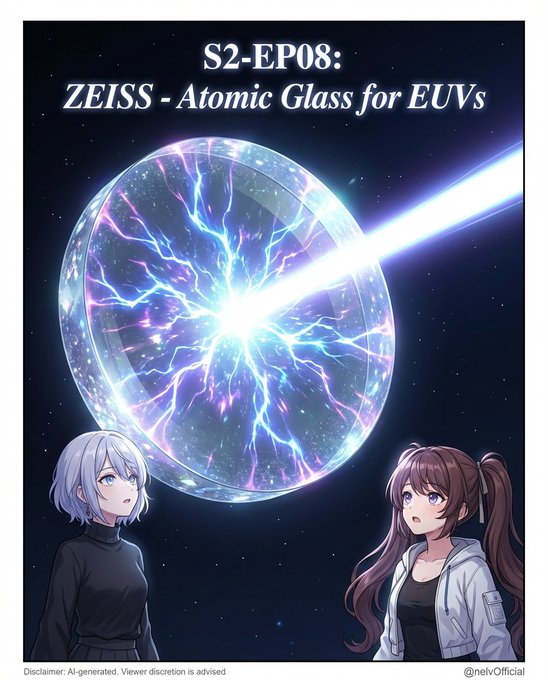
A multi-billion dollar failed assumption. The entire machine had to be redesigned. It has to operate in a perfect vacuum, and it can't use lenses. It has to use mirrors.
But not just any mirrors. They have to be the most perfect reflective surfaces ever created.
They are so smooth that if you scaled one up to the size of Germany, the biggest bump on it would be less than a tenth of a millimeter high. Any larger, and the EUV light would scatter, ruining the pattern.
So you have a star-in-a-box that only works in a vacuum and can only be aimed with impossible mirrors.
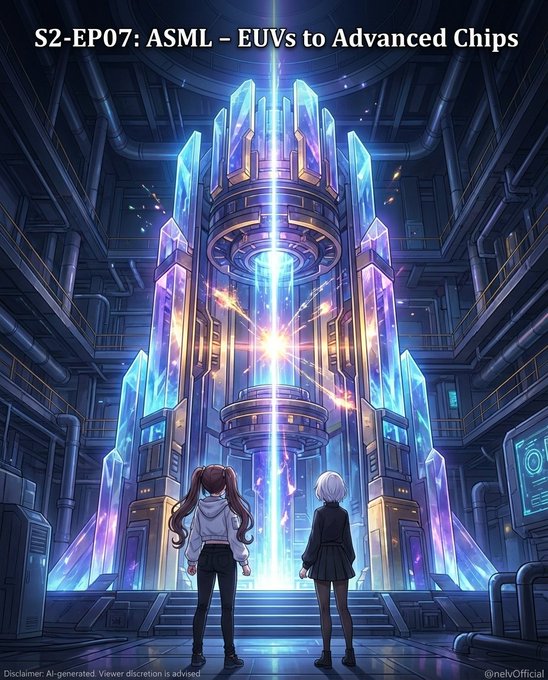
Now you see why it took 20 years and over a hundred billion dollars of research. And why ASML is the only company on Earth that can make one.
It's not a monopoly. It's a species of one. They're the only ones who survived the engineering challenges.
The barrier to entry isn't a patent. It's physics.
And that physical reality is what makes these machines the center of geopolitics. Software can be copied. This cannot.
The country that has the Star Forger...
...gets to build the future.