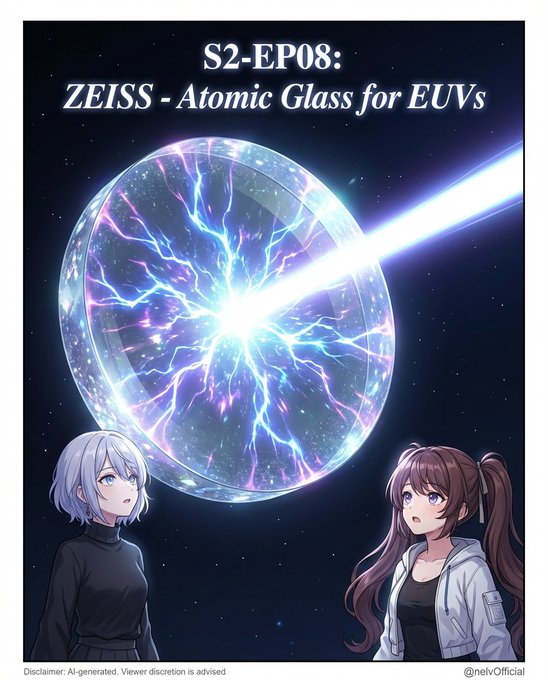
Tech / Season 2 / EP08
EUV Mirrors

Okay, I'm still not over this. The light is a tiny star... but how do you aim it?
Why not just... a lens? A really, really good one. Like a telescope lens. You just focus the light. Easy.

Your lens would last for approximately one picosecond. Then it would turn into a very expensive puff of smoke.
Kurumi! Why? A lens is just glass. It's transparent.
Transparent to *visible light*. To an EUV photon, glass is an opaque, black wall. The photon is so high-energy it doesn't pass through; it slams into the atoms and gets absorbed.
Okay, fine! No glass. So you use a mirror. A really, really shiny piece of metal. Like a perfect chrome sphere. Done.
Shez, let's use an analogy. Visible light is a tennis ball. Your chrome mirror is a concrete wall. The ball bounces off perfectly.
An EUV photon is a wad of sticky, wet chewing gum.
It just... sticks?
It gets absorbed. Its energy is too high. It gets tangled in the electron clouds of the metal atoms. It doesn't reflect. So, your perfect chrome mirror is useless. This is the problem that nearly killed the entire project.
You build a mirror that isn't a mirror. You build a trap that coaxes the light into bouncing. This is the masterpiece of **ZEISS**.
They knew a single surface was a dead end. So they built a mirror made of layers. Forty pairs of alternating Molybdenum and Silicon, each just a few atoms thick.
Like a cake?
An atomic lasagna. But the layers aren't the magic. The magic is in the *space between* the layers.
I don't get it. If one layer doesn't work, how can 80 layers work?
Because it's not a mirror. It's an **interference engine**. A single layer boundary reflects less than 1% of the light. Pathetic.
So... it's 99% useless?
Yes. But what if you could make a thousand useless things work together perfectly? Have you ever pushed someone on a swing?
Yeah...
Your first push does almost nothing. But if you give another tiny push at the *exact* right moment in the arc...
...the energy adds up. All those tiny, useless pushes, perfectly synchronized, create a massive result. **That** is what the ZEISS mirror does.
The thickness of each layer is calculated so that all 80 of those tiny, pathetic reflected waves travel back to the surface in perfect sync.
They interfere constructively. They add up. They become a single, powerful reflection. It's a mirror made not of material, but of perfectly timed echoes.
Exactly. But for the timing to work, the layers have to be perfect. And the whole thing has to be impossibly smooth.
It's an **atomic sandblaster**. They shave the surface, one atom at a time.
Okay, that's insane. But how do you know if it's smooth? You can't see an atom. Do they use a really, really good microscope?
Another good guess, but another dead end. A microscope uses light to see. You can't use a beach ball to measure the size of a grain of sand.
To measure the atomic-scale bumps, you need to hit them with something even smaller. You need to use X-rays from a **Synchrotron**.
They use a particle accelerator in Berlin to verify that the mirror is perfect.
Okay. Let me get this straight. You can't use a lens because it melts. You can't use a normal mirror because it's sticky.
Yeah, sounds about right.