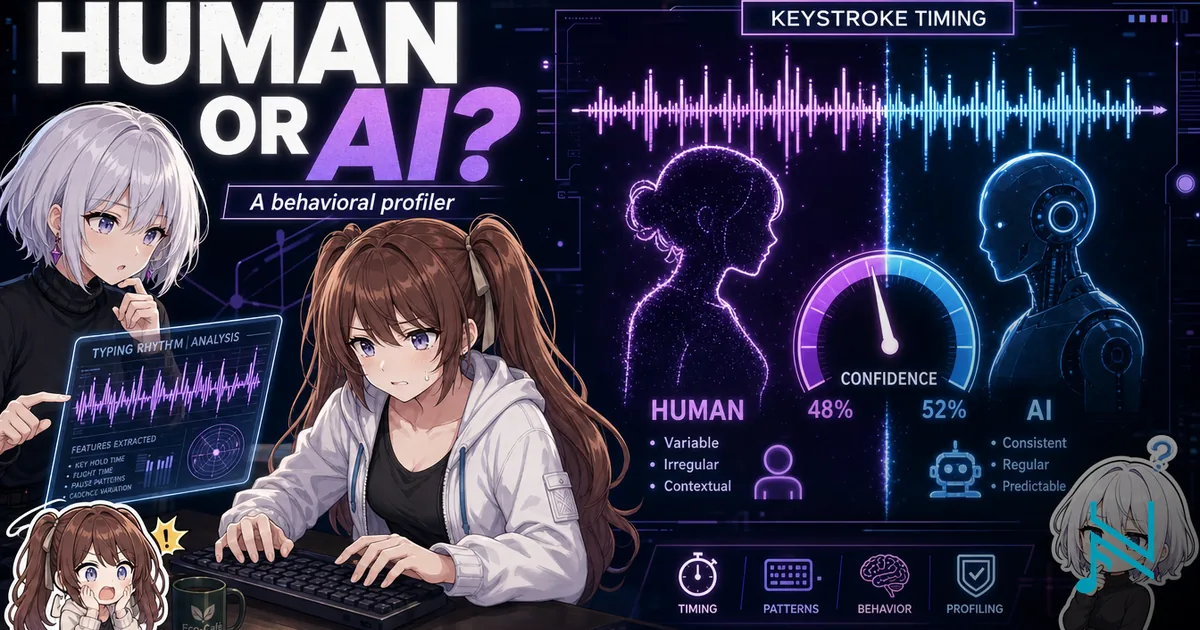
Human or AI?
A real-time behavioral profiler. The machine learns your patterns as you type — then tells you how human you look.
Humans are structure machines. We cannot escape pattern, not even when we try to generate randomness.
Press 0 or 1 as randomly as you can. The machine builds a probability model of your behavior in real time and outputs a confidence estimate of whether you are human.
I bet my money you will never get the number below 48% on this game.
Lets play a game!
Simulate Bot
A truly random process takes over. Watch the confidence line regress toward 50% — the machine cannot predict it.
Collecting data…
0 bits · last 48 shown · red ring = machine predicted correctly
What the machine is detecting
You carry four measurable tells. None requires access to your name, your ID, or your history.
| Tell | How you leak it | When it shows |
|---|---|---|
| Pattern memory | After pressing 1–0–1, you are more likely to press 0 than 1. The machine builds a conditional frequency table indexed to your last two moves and its own last two predictions, weighted toward recent behavior. | Exploitable by move 30 |
| Bit bias | You favor one digit. A structural bias from how your brain encodes "random." A fair coin has no favorite. A human does. | Early — detectable within 20–30 presses |
| Run avoidance | Long runs feel non-random, so you self-correct. A fair coin has no discomfort with ten identical flips in a row. You do. | Visible after 2–3 short runs |
| Alternation excess | You switch 0↔1 more often than chance predicts. A run of alternations feels random. It is not — as structured as a run of identical digits, just in the other direction. | Builds cumulatively with sequence length |
What this means
Low entropy is not a weakness in the information-theoretic sense. A low-entropy signal carries more predictable content -- that is, more information about the generator.
A perfectly random sequence tells you nothing about what comes next. A human sequence tells the machine exactly what comes next, with increasing confidence.
This is not specific to binary inputs. The same principle applies to every channel you interact through:
| Channel | What leaks |
|---|---|
| Sentence phrasing | Word choice distributions, sentence length patterns |
| Typing rhythm | Inter-keystroke timing, pause distribution before corrections |
| Mouse movement | Acceleration curves, corner-cutting tendencies |
| Scrolling behavior | How you hesitate, where you stop |
Each channel individually is weak. Combined across enough interactions, they produce a behavioral fingerprint more durable than a password and harder to consciously fake than a signature — because the patterns that leak are below the threshold of deliberate control.
What this really means?
It means in a world of big data, we are at the end of privacy and start of Palantir-like surveillance. You cannot sue for privacy violations because math produces ontologies that can reliably profile you.
As the simulation's Source Detection Fractal shows, tricking the machine isn't easy. You can't AI generate a few patterns to throw off a detection algorithm that has already locked-on to you. It knows when you are faking as a bot, and when you are back to your self.
The surveillance infrastructure is optional. A machine does not need access to your private records to profile you. It needs only that you interact with a system long enough for your patterns to stabilize -- which, as this game demonstrates, takes fewer moves than you expect.
The entropy reversal
The question "Human or AI?" is usually asked in one direction: detect machine-generated content in a stream of human-produced text. This is a hard problem. Large models now produce text that is statistically indistinguishable from human writing by most surface measures.
The inverse problem — detect human-generated behavior in a stream of apparent randomness — is actually the easier one.
| Direction | Problem | Difficulty | Why |
|---|---|---|---|
| Human → detect AI | Find machine-generated text in human streams | Hard | Large models produce statistically indistinguishable text |
| Machine → detect human | Find human behavior in apparent randomness | Easy | Humans leak structure involuntarily — memory, loss aversion, pattern preference cannot be turned off |
A cryptographic PRNG produces sequences that defeat this detector. A human trying to pass as a PRNG almost certainly cannot. The only mechanical giveaway a machine has is one it chooses to have — a deliberate tell, like a watermark. The human giveaway is involuntary.
A machine can profile a human more reliably than a human can predict a machine. Not because machines are smarter in any general sense, but because humans leak structure, and structure is exploitable.
This is actually grounds for Optimism, instead of Pessimism. The same principle that benefits a surveillance infrastructure is also a proof of Humanity and Humanness.
It means no matter how much a machine tries to mimic humans, they will always be a little too perfect to be you. The signals you create are more than what our machine friends can generate, and that will be the reason why a superAI will continue to cooperate with humanity.
References
- The Inverse Turing Test — calmcode.io
- Bad at Entropy — Man vs. Machine — loper-os.org · the original interactive predictor this is based on
Embedding Projector
Visualise high-dimensional embeddings in 3D and compare PCA vs UMAP projection. Mammoth point cloud, Fashion MNIST image embeddings, GloVe word vectors, and real blog post sentence embeddings — all precomputed, instant switching.
Image Forensics
Eight client-side instruments for reading image provenance — from EXIF metadata to frequency analysis, edge coherence, colour distribution, and texture statistics.